Solar panels are designed to operate outdoors for decades, but that does not mean they remain clean on their own. Dust, pollen, bird droppings, coastal residue, agricultural dust, airborne contaminants, and other debris can accumulate on the module surface and contribute to soiling-related production losses.
Rain may remove some loose surface dust, but it should not be considered a substitute for proper solar panel cleaning. Depending on the type of contamination, rain can also redistribute dirt and leave residue behind.
The important question is not simply how to clean solar panels, but how to clean them properly without unnecessarily risking personal safety, damaging the modules, or using a cleaning method that conflicts with the manufacturer’s recommendations.
How Should Rooftop Solar Panels Be Cleaned?
Solar panels should be cleaned using methods appropriate for the specific modules, installation, and site conditions.
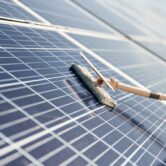
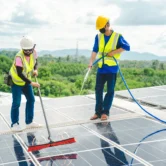
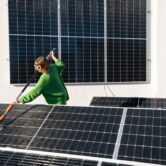
At The Solar Cleaners, our approach centers around professional cleaning equipment, rotating brushes, and filtered water. We do not use harsh chemicals or pressure washing as part of our standard solar panel cleaning process.
Before cleaning any system, the condition, accessibility, module type, roof configuration, and surrounding environment should be considered.
Whenever possible, cleaning methods should also be consistent with the module manufacturer’s published cleaning and maintenance requirements.
What Should Be Used to Clean Solar Panels?
There is no single cleaning procedure that should automatically be applied to every solar installation.
Professional solar cleaning generally involves equipment specifically designed to remove accumulated contaminants from module surfaces while minimizing unnecessary mechanical stress.
Common considerations include:
- Proper solar panel cleaning brushes and equipment
- Filtered water
- Appropriate water pressure and flow
- Module temperature
- Ambient temperature and weather conditions
- Type and severity of contamination
- Manufacturer cleaning requirements
- Roof and system accessibility
- Electrical and fall hazards
Different contaminants can also require different approaches. Loose dust is very different from bird droppings, lichen, biological growth, coastal residue, or contaminants associated with nearby industrial or commercial operations.
Does Rain Clean Solar Panels?
Rain can help remove some loose dust and pollen, but rain should not be confused with an actual solar panel cleaning.
Contaminants can adhere to module glass and accumulate over extended dry periods. Bird droppings and other localized contamination may remain even after substantial rainfall.
In areas such as Southern California, extended periods without meaningful rainfall can allow significant soiling to develop.
Roof pitch also matters. Water and contaminants behave differently on steeply pitched residential arrays than they do on low-slope commercial rooftops or nearly horizontal modules.
This is why cleaning requirements should be based on actual site conditions rather than the assumption that rainfall will keep an array clean.
How Often Should Solar Panels Be Cleaned?
There is no universal cleaning schedule that applies to every solar system.
The appropriate frequency depends on factors such as:
- Local dust conditions
- Proximity to freeways and high-traffic areas
- Coastal exposure
- Agricultural activity
- Nearby construction
- Trees and vegetation
- Bird activity
- Roof pitch
- Module orientation
- Seasonal weather
- Local rainfall
- The type of property and surrounding activity
Some systems may require cleaning more frequently, while others may go considerably longer between services.
For commercial properties, carports, ground-mounted arrays, and utility-scale systems, cleaning frequency may also be determined by operational requirements, production data, site inspections, and the economics of soiling losses.
Does Cleaning Solar Panels Improve Production?
- Cleaning can restore production that has been lost specifically because of soiling.
- However, a decline in solar production does not automatically mean the panels are dirty.
- Solar production can change because of numerous factors, including:
- Weather
- Seasonal changes in solar irradiance
- Module temperature
- Shading
- Inverter performance
- Electrical faults
- Equipment degradation
- Monitoring issues
- System downtime
- Soiling
Production data can be useful when evaluating a system, but a production decrease should not automatically be diagnosed as a cleaning issue without considering other possible causes.
Should Solar Panels Be Turned Off Before Cleaning?
Electrical safety around photovoltaic systems requires more consideration than simply switching off an inverter.
Solar modules generate DC electricity when exposed to sunlight. Depending on the system design and equipment installed, shutting down an inverter or operating a disconnect does not necessarily eliminate every electrical hazard at the array.
Shutdown and safety procedures can differ based on the inverter, rapid-shutdown equipment, disconnect configuration, system design, and manufacturer’s requirements.
For this reason, homeowners should not assume that turning off an inverter makes an entire rooftop solar array electrically de-energized or safe to work around.
Damaged modules, wiring, connectors, junction boxes, or other electrical components should also be treated seriously. If visible damage or an electrical issue is suspected, the appropriate solar or electrical professional should evaluate the system.
Can You Pressure Wash Solar Panels?
The Solar Cleaners does not use pressure washing as its standard method for cleaning solar modules.
High-pressure water is unnecessary for routine professional solar panel cleaning and, when used improperly, may create unnecessary risk to modules, seals, electrical components, mounting systems, or other parts of the installation.
Module manufacturers may also establish specific limitations regarding water pressure, cleaning equipment, water quality, chemicals, and acceptable cleaning procedures.
For these reasons, cleaning should follow the applicable manufacturer’s recommendations rather than assuming that a pressure washer is appropriate for every module.
Can You Use Soap, Vinegar, or Household Cleaners on Solar Panels?
Household cleaning products should not automatically be considered appropriate for solar modules.
Products such as dish soap, vinegar, glass cleaner, bleach, ammonia-based products, abrasive cleaners, and other household chemicals may leave residue or may not comply with a particular module manufacturer’s cleaning instructions.
The safest approach is to follow the manufacturer’s requirements and use a professional cleaning process appropriate for photovoltaic modules.
At The Solar Cleaners, we focus on mechanical cleaning using professional equipment and filtered water rather than relying on harsh cleaning chemicals.
Why Module Temperature Matters
Solar modules can become extremely hot when exposed to direct sunlight.
Cleaning conditions should take module temperature into consideration. Introducing significantly cooler water onto extremely hot module glass can create unnecessary thermal stress, and excessive heat can also cause water to evaporate quickly during the cleaning process.
Manufacturer specifications should always take precedence when they establish temperature limitations or specific cleaning conditions.
Professional solar cleaning therefore involves more than simply choosing a convenient time of day. Conditions at the actual site and the requirements of the equipment being cleaned need to be considered.
Should Homeowners Clean Rooftop Solar Panels Themselves?
Rooftop solar cleaning involves more than removing dirt from glass.
A rooftop environment can combine several hazards at the same time:
- Heights
- Sloped surfaces
- Wet roofing materials
- Ladders
- Electrical equipment
- Solar modules that can remain electrically active in sunlight
- Equipment and wiring that may not be easily inspected from the ground
A homeowner should never walk on solar modules or place body weight on them.
If panels cannot be safely accessed and cleaned without creating fall, electrical, or equipment-damage risks, professional solar panel cleaning is the appropriate option.
Why Professional Solar Panel Cleaning Matters
Professional solar cleaning is not simply about making panels look clean.
The objective is to remove accumulated contamination using equipment and procedures appropriate for photovoltaic systems while protecting the modules, surrounding equipment, property, and personnel.
At The Solar Cleaners, we specialize in solar panel cleaning for residential, commercial, and large-scale solar installations. Our cleaning process uses professional rotating-brush equipment and filtered water without pressure washing or harsh chemicals.
Every solar installation is different. The appropriate cleaning frequency and method should be based on the actual system, environment, accessibility, and type of contamination present.
Frequently Asked Questions
How often should rooftop solar panels be cleaned?
There is no universal schedule. Cleaning frequency depends on environmental conditions, system design, roof pitch, surrounding activity, rainfall, bird activity, and the amount and type of contamination present.
Does rain clean solar panels?
Rain can remove some loose surface material, but it is not equivalent to professional cleaning. Contaminants can remain attached to module glass even after rainfall.
What should be used to clean solar panels?
Cleaning equipment and procedures should be appropriate for photovoltaic modules and consistent with the module manufacturer’s requirements. The Solar Cleaners uses professional cleaning equipment, rotating brushes, and filtered water.
Can I use Dawn dish soap on solar panels?
We do not recommend automatically applying household detergents to solar modules. Cleaning products should only be used when appropriate for the specific module and consistent with manufacturer requirements.
Can vinegar be used on solar panels?
We do not recommend vinegar as a general solar panel cleaning solution. Manufacturer-approved cleaning procedures should take precedence over homemade cleaning solutions.
Can solar panels be pressure washed?
The Solar Cleaners does not use pressure washing as its standard module-cleaning method. High-pressure water is unnecessary for routine cleaning and may conflict with manufacturer requirements or create unnecessary risk when improperly used.
Does turning off the inverter make solar panels electrically safe?
Not necessarily. Photovoltaic modules can continue generating DC electricity when exposed to sunlight. System shutdown procedures and the electrical condition of an array depend on the specific system design and equipment.
How do I know when my solar panels need cleaning?
Visible contamination, environmental conditions, the amount of time since the previous cleaning, site inspections, and production data can all be considered. A production decrease alone should not automatically be attributed to dirty panels because many other factors can affect solar output.
Keep Your Solar Investment Performing
Solar panels operate continuously in an outdoor environment. Over time, exposure to dust, pollution, bird activity, coastal conditions, vegetation, and other contaminants can create a level of soiling that rainfall alone may not remove.
Proper solar panel cleaning should be based on the actual conditions of the system—not generic cleaning schedules or one-size-fits-all DIY instructions. If your solar panels are visibly soiled or you are unsure whether your system is due for cleaning, The Solar Cleaners can evaluate the system and recommend an appropriate cleaning schedule based on the property and environmental conditions.