
How Dirty Do Solar Panels Get in Southern California?
Solar panels in Southern California can get dirty faster than many owners expect. Dust, pollen, bird droppings, traffic film, agricultural residue, and dry seasonal conditions can all leave buildup on the glass. In some cases, the surface only looks dusty. In other situations, the contamination is heavy enough that professional cleaning becomes a practical maintenance issue rather than a cosmetic one.
How dirty solar panels get depends on location, weather, surrounding activity, roof design, tilt angle, and how long the system goes without service. As a result, residential and commercial systems across Southern California often collect meaningful buildup over time, especially in inland, dry, windy, agricultural, or high-traffic areas.
Why Solar Panels Get Dirty in Southern California
Southern California creates conditions that regularly leave residue on solar panel glass. Long dry stretches, airborne dust, landscaping debris, and limited natural rinsing all contribute to accumulation. In coastal areas, properties may also see salt-related film, while inland locations often deal more with dust, pollen, and windblown debris.
Common sources of solar panel buildup in Southern California include:
- Dust from dry weather and wind
- Pollen and tree residue
- Bird droppings
- Traffic film near roads and freeways
- Construction dust
- Agricultural residue in farming areas
- Airborne grime from nearby industrial activity
Not every system soils at the same rate. For example, a clean-looking array can still have a light layer of film across the glass, while another system may show obvious spots, streaking, or concentrated buildup in certain rows or corners.
Do Solar Panels Usually Get Light Dust or Heavy Buildup?
Both happen. Many systems mainly collect a thin layer of dust that builds gradually between rain events or cleanings. By contrast, other arrays develop heavier contamination that includes bird droppings, sticky residue, dense pollen, or dirt that clings more aggressively to the glass.
This distinction matters because there is a difference between cosmetic dirt and meaningful buildup. Cosmetic dirt may make the system look slightly dull but not always justify immediate service. More meaningful buildup, however, is the kind of contamination that is persistent, uneven, concentrated, or heavy enough that cleaning becomes part of responsible maintenance.
Examples of more meaningful buildup include:
- Bird droppings that dry onto the glass
- Patches of grime near roof edges or low spots
- Sticky residue from trees or environmental fallout
- Heavy dust after nearby construction or strong wind events
- Dirty panels on commercial sites near traffic, warehouses, or agricultural areas
Which Southern California Properties Get Dirty Faster?
Some sites predictably soil faster than others. In most cases, the dirtiest systems are not random. Instead, they tend to be in places where airborne contamination, access issues, or long service intervals allow buildup to remain on the glass.
Systems that often get dirty faster include:
- Homes near busy roads or freeway corridors
- Properties near agriculture, open land, or horse facilities
- Buildings under trees or near heavy landscaping
- Commercial rooftops near warehouses or industrial areas
- Carports exposed to traffic, dust, and bird activity
- Ground-mounted arrays in dry, open environments
Southern California does not have one single soiling pattern. For example, a coastal home in San Diego County may deal with marine film and birds, while an inland commercial property may deal more with dust, pollen, and dry grime from surrounding activity.
How Fast Can Solar Panels Get Dirty?
There is no single timeline that fits every system. Some panels look noticeably dirtier within a few months, while others take longer. Ultimately, a lot depends on weather, rainfall, site conditions, and whether the buildup is loose surface dust or more stubborn contamination.
In Southern California, many systems go through long dry periods without enough rain to meaningfully rinse the glass. Even when it does rain, that does not always remove stuck-on residue or heavier contamination. Instead, bird droppings, grime, and adhered dirt often remain.
Because of that, routine solar panel cleaning services are often evaluated based on site conditions rather than appearance alone.
Why the Cleaning Method Matters
The cleaning method matters because dirty solar panels are only part of the issue. Professional solar panel cleaning is not the same as casually rinsing panels with a hose or brushing them with the wrong tool.
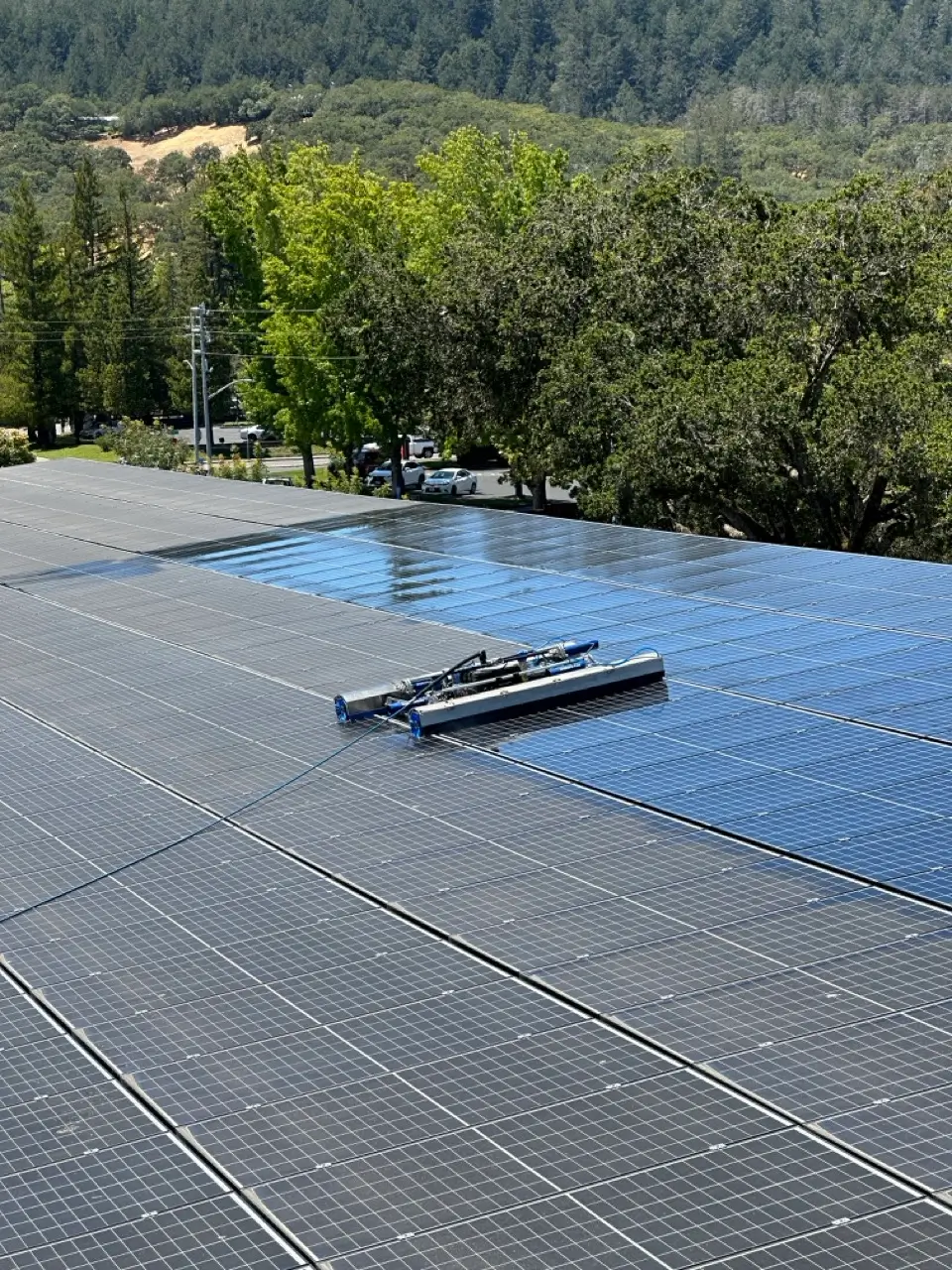
For many systems, especially larger or more contaminated ones, professional rotating-brush equipment provides a more controlled and effective cleaning method than basic water-fed pole cleaning. Water-fed poles may be useful in limited situations. However, they are not the same as purpose-built rotating brush systems designed for solar module cleaning.
The right approach depends on:
- Roof type and pitch
- Array layout and spacing
- Access limitations
- Contamination level
- Safety requirements
- Water supply logistics
- Whether the system is residential, commercial, carport, or ground-mounted
Therefore, professional service should be matched to the site rather than treated like general exterior washing.
Residential vs. Commercial Solar Panel Dirt in Southern California
Residential Systems
Residential systems often collect dust, pollen, bird droppings, and tree-related residue. Roof pitch, surrounding vegetation, and neighborhood conditions can make a big difference. In addition, a two-story home with limited access may require a different cleaning approach than a single-story home with easier roof lines.
Commercial Systems
Commercial solar panels often face broader contamination patterns across larger arrays. For example, rooftop systems may collect HVAC-related grime, airborne dust, and traffic film. Meanwhile, carport systems often deal with birds, vehicle-related dirt, and open exposure. Ground-mounted and utility-scale arrays can also face repeated dust loading depending on site conditions and maintenance schedules.
For larger systems, cleaning is usually a maintenance planning issue, not just a visual one. See our commercial solar panel cleaning services and utility-scale solar cleaning services for more on how service differs by project type.
Signs Your Solar Panels May Be Dirtier Than They Look
Some systems do not appear severely dirty from the ground, but a closer inspection tells a different story. Dirt is not always dramatic. Instead, it can appear as a dull film, uneven haze, or isolated contamination that affects portions of the array more than others.
Common signs include:
- A visible film on the glass in morning or evening light
- Bird droppings or clustered residue on certain modules
- Dust accumulation around frame edges
- Uneven appearance across rows
- Grime after wind events, landscaping work, or nearby construction
- Long periods without inspection or cleaning
When Should You Bring in a Professional?
A homeowner, property manager, or asset manager should consider professional cleaning when the buildup is no longer just light dust, when access is not straightforward, or when the system type calls for specialized equipment and a controlled process.
Professional service is usually worth considering when:
- There are bird droppings or adhered contamination on the glass
- The array is difficult or unsafe to access
- The system is on a commercial roof or carport
- The site has recurring dust, pollen, or environmental residue
- The array has gone a long time without proper cleaning
- The system owner wants a method designed specifically for solar modules
For homeowners in the region, our residential solar panel cleaning service explains what professional cleaning involves and when it makes sense to schedule it.
FAQ: How Dirty Do Solar Panels Get in Southern California?
Do solar panels get dirty quickly in Southern California?
They can. Dry weather, dust, pollen, birds, and traffic exposure can cause noticeable buildup faster than many owners expect, especially in inland and high-exposure areas.
Does rain clean solar panels in Southern California?
Rain may remove some loose dust. However, it often does not fully clean stuck-on residue, bird droppings, or heavier grime.
Are dirty solar panels just a cosmetic issue?
Not always. Light dust may be mostly cosmetic for a period of time, but heavier or uneven buildup is a maintenance concern and should be evaluated accordingly.
Do commercial solar panels get dirtier than residential panels?
Often yes, especially on large rooftops, carports, and ground-mounted sites exposed to traffic, dust, industrial activity, or birds.
What is the best way to clean dirty solar panels?
The best method depends on the system, access, safety, and contamination level. In most cases, professional solar-specific equipment and methods are preferable to improvised cleaning approaches.
What to Know About Solar Panel Dirt in Southern California
- Southern California solar panels commonly collect dust, pollen, bird droppings, and environmental residue.
- Some dirt is cosmetic, but heavier buildup can become a maintenance issue.
- Site conditions strongly affect how fast panels get dirty.
- Commercial, carport, and ground-mounted systems often require more structured cleaning planning.
- The cleaning method matters, especially when access, safety, and contamination are more complex.
If your solar panels in Southern California are showing visible buildup or have gone too long without service, contact The Solar Cleaners to discuss the right cleaning approach for your residential or commercial system.